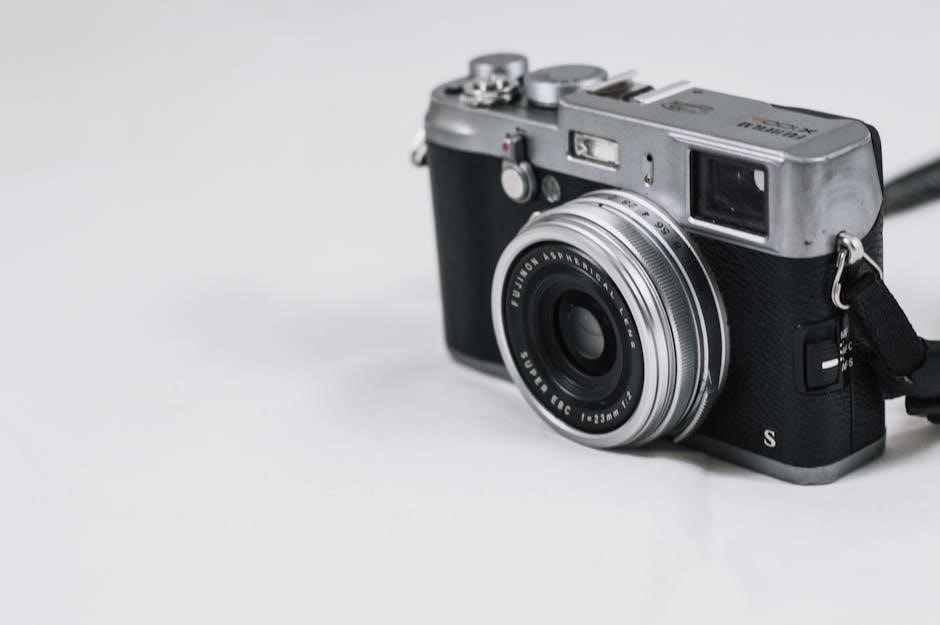
The Canon EOS Rebel T1i, a 15.1-megapixel DSLR, offers detailed specifications and comprehensive manuals readily available as PDF downloads from Canon’s official website.
What is the Canon Rebel T1i?
The Canon EOS Rebel T1i, also known as the EOS 500D, is a digital single-lens reflex (DSLR) camera renowned for its 15.1-megapixel CMOS sensor. Released as a popular entry-level DSLR, it delivers impressive image quality and a range of features for both beginners and enthusiasts.
Detailed specifications, covering resolutions like 2352 x 1568, 3456 x 2304, and 4752 x 3168, are readily accessible. Crucially, comprehensive instruction manuals are available for free PDF download, providing users with detailed guidance on every aspect of the camera’s operation, from basic settings to advanced techniques. These manuals ensure a smooth learning curve.
Key Features and Specifications
The Canon Rebel T1i boasts a 15.1-megapixel CMOS sensor, supporting 3:2 aspect ratios and delivering high-resolution images. Its ISO sensitivity ranges from 100 to 6400, enabling shooting in various lighting conditions. The camera captures still images at resolutions of 2352×1568, 3456×2304, and 4752×3168.
Accessing the detailed instruction manual, available as a free PDF download, is crucial for understanding these features. The manual comprehensively explains the camera’s specifications, including battery details (like the ED05F-08-8 Lithium-Ion Battery) and optimal settings for maximizing image quality. It’s an essential resource for mastering the T1i’s capabilities.
Getting Started
Consult the Canon Rebel T1i’s manual (available as a PDF) for guidance on initial setup, battery charging, and memory card insertion procedures.
Unboxing and Initial Setup
Upon unboxing your Canon EOS Rebel T1i, carefully inspect all included components, referencing the detailed inventory list within the camera’s manual. The PDF version, downloadable from Canon’s website, provides visual aids. Initial setup involves attaching the battery and memory card – instructions are clearly outlined. Connect the camera to a computer via USB, as detailed in the manual, to ensure proper driver installation; Familiarize yourself with the camera’s basic layout and button functions before proceeding. The manual emphasizes the importance of registering your camera online for warranty purposes and accessing further support resources. Proper initial setup guarantees optimal performance and a smooth user experience.
Battery and Charging
The Canon Rebel T1i utilizes a Lithium-Ion battery, detailed in the manual’s specifications (like the ED05F-08-8 model). The manual stresses using only Canon-approved chargers to prevent damage. Initial charging, as outlined in the PDF manual, takes approximately 1.5-3 hours. A charging indicator light signals completion. Avoid interrupting the charging process. The manual advises storing fully charged batteries for extended periods to maintain optimal capacity. Always remove the battery if the camera won’t be used for a prolonged time. Refer to the manual for battery care guidelines and troubleshooting tips regarding charging issues.
Inserting and Removing Memory Cards
The Canon Rebel T1i manual details proper memory card handling. Locate the card slot, typically on the side of the camera, as illustrated in the PDF. Gently insert the card, label-side up, until it clicks into place. To remove, press the release latch – do not force it. The manual cautions against removing a card during data transfer. Supported card types are specified within the manual. Always consult the manual for compatibility. Incorrect insertion or forceful removal can damage both the card and the camera. Proper handling, per the manual, ensures data integrity.

Understanding the Camera Interface
The Canon Rebel T1i manual explains the mode dial, buttons, LCD screen, and menu navigation for intuitive operation, as detailed in the PDF.
The Mode Dial
The Canon Rebel T1i’s mode dial, thoroughly explained in the camera’s manual, is central to controlling shooting settings. It features options like Full Auto for simplicity, Program (P) for semi-automatic control, Aperture Priority (Av) for depth-of-field adjustments, and Shutter Priority (Tv) for motion control.
Manual Mode (M) grants full creative control over both aperture and shutter speed. Additional settings include scene modes for portraits, landscapes, and sports, alongside movie recording. The PDF manual provides detailed illustrations and explanations of each mode, ensuring users can effectively utilize the T1i’s capabilities and achieve desired photographic results.
Buttons and Controls Overview
The Canon Rebel T1i’s button layout, detailed within the comprehensive instruction manual (available as a PDF), offers intuitive operation. Key controls include the shutter button, main dial for settings adjustments, and a cross-key controller for menu navigation and autofocus point selection.
Dedicated buttons provide quick access to ISO, white balance, and picture style settings. The ‘Set’ button confirms selections, while the ‘Disp’ button toggles information display on the LCD screen. The manual clearly illustrates each button’s function, enabling users to efficiently navigate the camera’s features and customize settings for optimal performance.
LCD Screen and Menu Navigation
The Canon Rebel T1i features a 2.5-inch LCD screen for image review and menu navigation, thoroughly explained in the downloadable PDF instruction manual. The menu system is logically organized into sections – Shooting, AF, Setup, and My Menu – accessible via the cross-key controller.
Users can easily scroll through options and confirm selections using the ‘Set’ button. The manual details each menu item, clarifying its function and available settings. The LCD displays shooting information, histograms, and playback options, enhancing the overall user experience and facilitating informed camera control.

Shooting Modes
The Canon Rebel T1i manual details various shooting modes – Auto, Program, Aperture Priority, Shutter Priority, and Manual – for flexible photographic control.
Auto Mode (Full Auto)
Auto Mode, as explained in the Canon Rebel T1i manual, is the simplest shooting option, ideal for beginners. The camera automatically selects all settings – aperture, shutter speed, ISO, and white balance – optimizing them for the scene. This “point-and-shoot” functionality allows users to quickly capture images without needing to understand complex photographic principles.
The manual emphasizes that while convenient, Auto Mode offers limited creative control. It’s perfect for everyday snapshots, but photographers desiring specific effects or adjustments should explore other modes. The camera’s intelligent scene detection further enhances Auto Mode, recognizing common subjects like portraits or landscapes to refine settings accordingly, ensuring consistently good results.
Program Mode (P)
Program Mode (P), detailed in the Canon Rebel T1i manual, offers a balance between automatic operation and creative control. The camera automatically sets the aperture and shutter speed, but allows the photographer to adjust ISO, white balance, and exposure compensation; This mode is excellent for situations where you want a quick setup but still desire some influence over the final image.
The manual highlights that Program Mode is a step up from Full Auto, providing more flexibility without the complexity of fully manual settings. Users can fine-tune the exposure to achieve desired brightness or depth of field, making it suitable for varied shooting conditions and artistic preferences.
Aperture Priority Mode (Av)
The Canon Rebel T1i manual explains that Aperture Priority Mode (Av) lets you control the lens aperture, influencing depth of field, while the camera automatically selects the shutter speed for proper exposure. A wider aperture (lower f-number) creates a shallow depth of field, ideal for portraits with blurred backgrounds. Conversely, a narrower aperture (higher f-number) maximizes depth of field, suitable for landscapes.
The manual emphasizes Av mode’s usefulness when creative control over focus is paramount. Photographers can prioritize background blur or sharpness, adjusting other settings like ISO and exposure compensation to achieve the desired result. It’s a powerful tool for artistic expression.
Shutter Priority Mode (Tv)
According to the Canon Rebel T1i manual, Shutter Priority Mode (Tv) allows photographers to dictate the shutter speed, controlling motion blur and freezing action, while the camera automatically adjusts the aperture for correct exposure. Faster shutter speeds (e.g., 1/1000s) are perfect for capturing fast-moving subjects like sports, preventing blur. Slower shutter speeds (e.g., 1/30s) can intentionally create motion blur, conveying a sense of movement.
The manual details how Tv mode is beneficial for situations demanding precise control over time, like panning shots or capturing waterfalls with a silky smooth effect. Remember to consider ISO alongside shutter speed for optimal image quality.
Manual Mode (M)
The Canon Rebel T1i manual explains that Manual Mode (M) grants the photographer complete creative control over both aperture and shutter speed. This mode requires understanding the exposure triangle – the interplay between aperture, shutter speed, and ISO – to achieve desired results. It’s ideal for challenging lighting conditions or when a specific look is desired, bypassing the camera’s automatic settings.
The manual emphasizes that in M mode, you directly set both f-stop (aperture) and shutter speed, monitoring the light meter to ensure proper exposure. Mastering M mode unlocks full artistic potential, though it demands practice and a solid grasp of photographic principles.

Focusing and Image Quality
The Canon Rebel T1i manual details autofocus modes, focus point selection, and ISO settings, crucial for achieving sharp images with minimal noise.
Autofocus Modes
The Canon Rebel T1i manual thoroughly explains the camera’s autofocus (AF) capabilities. It details One-Shot AF, ideal for stationary subjects, locking focus when the shutter button is half-pressed. Continuous AF, conversely, tracks moving subjects, continuously adjusting focus for dynamic scenes.
Furthermore, the manual clarifies AF point selection methods – automatic, manual single-point, and manual nine-point selection – allowing precise control over where the camera focuses. Understanding these modes, as outlined in the manual, is vital for capturing consistently sharp images, whether photographing portraits, landscapes, or fast-action sports. The manual also provides troubleshooting tips for focusing issues.
Focus Points Selection
The Canon Rebel T1i manual dedicates a section to understanding focus point selection, crucial for precise image control. Users can choose from automatic selection, where the camera decides the focus point, or manual selection for greater accuracy. The camera offers nine focus points, allowing photographers to pinpoint the desired area of sharpness.
The manual details how to navigate the menu to individually select a focus point or utilize the directional buttons for quick adjustments. It also explains the benefits of single-point AF versus nine-point AF, depending on the scene. Mastering focus point selection, as described in the manual, significantly enhances image quality and creative control.
ISO Settings and Noise Reduction
The Canon Rebel T1i manual thoroughly explains ISO settings, ranging from 100 to 3200, and their impact on image brightness and noise. Lower ISO values (100-400) are ideal for well-lit conditions, producing cleaner images. Higher ISOs (800-3200) are useful in low light, but introduce more digital noise.
The manual details the camera’s built-in noise reduction features, offering options to minimize noise at higher ISOs. Users can adjust the strength of noise reduction in the menu. Understanding the trade-off between brightness and noise, as outlined in the manual, is key to achieving optimal image quality in various shooting scenarios.
Image Quality Settings (RAW vs. JPEG)
The Canon Rebel T1i manual clearly explains the difference between shooting in RAW and JPEG formats. JPEG files are compressed, resulting in smaller file sizes, but with some loss of image data. RAW files, conversely, contain all image data captured by the sensor, offering greater flexibility for post-processing.
The manual details how RAW files allow for extensive adjustments to white balance, exposure, and other settings without significant quality loss. While JPEGs are convenient for immediate use, the manual recommends RAW for serious photographers seeking maximum control and quality in their final images. Selecting the appropriate format is crucial.

Using the Flash
The Canon Rebel T1i manual details built-in flash modes and compatibility with external flashes, offering expanded lighting options for diverse photographic scenarios.
Built-in Flash Modes
The Canon EOS Rebel T1i’s manual thoroughly explains its integrated flash functionalities. Users can select from several modes to suit various shooting conditions. Auto mode lets the camera determine when flash is needed, while flash on forces the flash to fire with every shot. Flash off disables the built-in flash entirely, allowing for natural lighting or external flash use. Red-eye reduction minimizes the red-eye effect in portraits by emitting pre-flashes.
Furthermore, the manual details slow-sync flash, which combines a slower shutter speed with the flash, useful for capturing ambient light and subject motion in darker environments. Understanding these modes, as outlined in the manual, is crucial for achieving optimal image quality and creative control.
External Flash Compatibility
The Canon Rebel T1i’s manual details its compatibility with a range of Canon EX-series Speedlites. Utilizing an external flash offers photographers greater control over lighting and power compared to the built-in flash. The manual explains how to attach and detach Speedlites using the hot shoe, and how to navigate the flash settings through the camera’s menu.
It also covers wireless flash options, enabling off-camera flash setups for more creative lighting arrangements. The manual provides guidance on setting up and synchronizing multiple flashes, enhancing photographic possibilities. Understanding these features, as described in the manual, unlocks advanced lighting techniques.

Video Recording
The Canon Rebel T1i manual explains video settings, recording options, and sound adjustments for capturing high-definition videos with this DSLR camera.
Video Recording Settings
The Canon Rebel T1i’s manual details crucial video settings for optimal results. Users can select from various resolutions, including standard definition and high definition (HD) at 720p, impacting file size and quality. Frame rates are also adjustable, typically offering 24fps for a cinematic look or 30fps for standard video.
Understanding these settings is vital for achieving desired video aesthetics. The manual further explains how to adjust the aperture and shutter speed for controlling depth of field and motion blur during video capture. Proper configuration ensures well-exposed and visually appealing videos, maximizing the camera’s capabilities.
Sound Recording Options
The Canon Rebel T1i’s manual outlines its limited, yet functional, sound recording capabilities. The camera features a built-in microphone for capturing audio alongside video, though external microphone options aren’t natively supported without adapters. Users can adjust the audio level within the camera’s menu, ensuring clear and audible sound without distortion.
The manual emphasizes the importance of minimizing background noise during recording for optimal audio quality; While not offering advanced audio controls, understanding the available settings allows for basic sound adjustments. For professional-grade audio, the manual suggests exploring external recording solutions.
Menu Settings Explained
The Canon Rebel T1i manual details extensive menu options, including Custom Functions and Picture Style Settings, for personalized image control and camera operation.
Custom Functions
Canon’s Rebel T1i provides a robust set of Custom Functions, detailed within the camera’s manual, allowing photographers to tailor the camera’s operation to their specific shooting styles. These functions cover a wide range of settings, from autofocus behavior and image quality preferences to button assignments and display options. Users can personalize the AE lock/focus mode, the shutter button half-press function, and even the behavior of the Quick Control screen.
The manual guides users through each function, explaining its purpose and available options. By customizing these settings, photographers can streamline their workflow, improve efficiency, and achieve greater creative control over their images. Exploring these functions is key to unlocking the full potential of the Rebel T1i.
Picture Style Settings
The Canon Rebel T1i’s manual extensively details the Picture Style settings, offering photographers creative control over the look of their images directly within the camera. These presets – Standard, Portrait, Landscape, Neutral, Faithful, and Monochrome – adjust sharpness, contrast, color saturation, and tone. Users can further customize each style, fine-tuning these parameters to achieve their desired aesthetic.
The manual explains how to register custom Picture Styles, saving personalized settings for consistent results. Understanding these settings allows photographers to minimize post-processing and obtain images that closely match their vision straight from the camera, enhancing creative expression.
Date and Time Settings
The Canon Rebel T1i manual clearly outlines how to accurately set the date and time within the camera’s menu system. Correct date and time settings are crucial for proper image file organization and metadata tagging, enabling efficient workflow and archiving. The manual details navigating to the ‘Set Date/Time’ function and adjusting the year, month, day, hour, and minute.
Furthermore, the manual explains the option to choose between a 12-hour or 24-hour clock format. Accurate timekeeping also impacts the functionality of features like time-lapse photography, ensuring precise interval recording. Maintaining correct settings is vital for seamless image management.

Troubleshooting Common Issues
The Canon Rebel T1i manual addresses frequent problems like camera power failures, focusing difficulties, and deciphering error messages for quick resolution.
Camera Not Turning On
If your Canon Rebel T1i fails to power on, the manual suggests several checks. First, ensure the battery is correctly inserted and fully charged, referencing the battery specifications within the manual. Verify the battery contacts are clean and free of obstruction.
Next, confirm the mode dial isn’t set to ‘OFF’. A depleted or incompatible battery can also cause this issue; consult the manual for approved battery types. If the problem persists, attempt a reset by removing and reinserting the battery. The manual details these steps for troubleshooting power-related concerns.
Focusing Problems
If experiencing focusing issues with your Canon Rebel T1i, the manual recommends checking the autofocus (AF) mode. Ensure it’s set appropriately for your subject – One-Shot for static subjects, AI Servo for moving ones. Verify sufficient light is available, as low light impacts AF performance, as detailed in the manual.
Confirm the selected focus point aligns with your intended subject. Try switching to manual focus to determine if the lens itself is the problem. The manual provides guidance on selecting and using focus points effectively. Clean the lens contacts and ensure nothing obstructs the lens’s focusing mechanism.
Error Messages
The Canon Rebel T1i’s manual details various error messages and their solutions. “Err 99” often indicates a shutter curtain issue, requiring professional service. “Err 80” suggests a memory card problem – try a different card or format the existing one. The manual stresses the importance of using Canon-approved memory cards.
If you encounter an unfamiliar error, the manual advises noting the exact message and consulting Canon’s support website. Avoid forcing the camera to operate if an error persists, as this could cause further damage. Referencing the manual’s troubleshooting section is the first step to resolving these issues.

Maintaining Your Canon Rebel T1i
The manual recommends regular sensor cleaning and proper battery care to ensure optimal performance and longevity of your Canon EOS Rebel T1i.
Cleaning the Sensor
Maintaining a clean sensor is crucial for optimal image quality with your Canon Rebel T1i. Dust particles can appear as spots in your photos, especially at smaller apertures. The manual details a self-cleaning mechanism, but periodic manual cleaning may be necessary.
Before attempting sensor cleaning, ensure the camera is fully charged. Use a blower to remove loose dust first. If stubborn particles remain, consider using a sensor cleaning kit specifically designed for DSLR cameras. Follow the manual’s instructions carefully to avoid damaging the sensor. Improper cleaning can void your warranty, so proceed with caution and consider professional cleaning if unsure.
Battery Care
Proper battery care extends the life and performance of your Canon Rebel T1i’s lithium-ion battery. The manual recommends fully charging the battery before its first use. Avoid extreme temperatures, as heat and cold can reduce battery capacity.
When storing the camera for extended periods, partially charge the battery to around 40-60% to prevent over-discharge. Do not leave a fully charged battery unused for long durations. Only use Canon-approved chargers to avoid damage. Avoid short-circuiting the battery terminals. Refer to the manual for detailed safety precautions and disposal guidelines.

Downloading the Manual
Canon provides the EOS Rebel T1i instruction manual as a free PDF download on their official website, offering comprehensive guidance for camera operation.
Official Canon Website
Canon’s official website serves as the primary hub for accessing the EOS Rebel T1i instruction manual and supplementary resources. Users can navigate to the support section of the website and search for the T1i model to locate available downloads. These typically include the complete owner’s manual in PDF format, providing detailed explanations of all camera functions, settings, and troubleshooting tips.
Beyond the core manual, Canon often provides additional documentation such as software drivers, firmware updates, and helpful guides to enhance the user experience. Regularly checking the official website ensures access to the latest information and support materials for your Rebel T1i camera.
PDF Manual Availability
The Canon EOS Rebel T1i instruction manual is widely available for free download in PDF format. This digital version replicates the printed manual, offering convenient access on computers, tablets, and smartphones. The PDF format allows users to easily search for specific topics, zoom in on diagrams, and print relevant sections for quick reference during shooting.
Multiple websites archive these manuals, ensuring continued accessibility even if the original link changes. Downloading the PDF provides a readily available resource for understanding the camera’s features and resolving any operational questions.